Thomasville Center for the Arts · My Side of the Story · 2026
A narrative quilt by Jacqueline Jenkins
"Don't let it be forgot, that once there was a spot,
for one brief shining moment that was known as Camelot."
Story
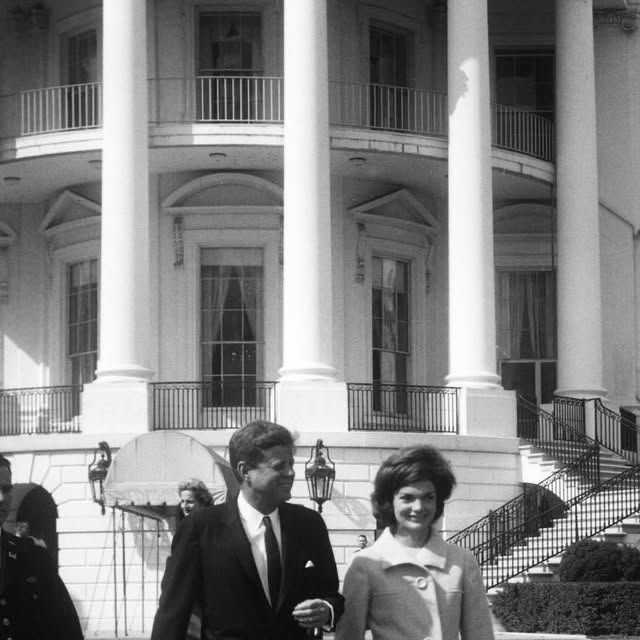
In February 1964 — three months after Dallas, six months after the death of her infant son Patrick — Jacqueline Kennedy retreated to Greenwood Plantation in Thomasville, Georgia.
She came as a guest of the Whitneys. She came without cameras, without press, without the watching world. She came to a Greek Revival portico Stanford White called the most perfect example of its kind in America, and she walked its gravel path through a Southern garden and began, slowly, to survive.
This quilt tells that story — the private story, the one that happened after the motorcade and before the myth solidified into marble. The story of a woman who needed somewhere to put the pieces.
"I kept thinking of a line from a song that Jack loved. 'Don't let it be forgot, that once there was a spot, for one brief shining moment that was known as Camelot.'"
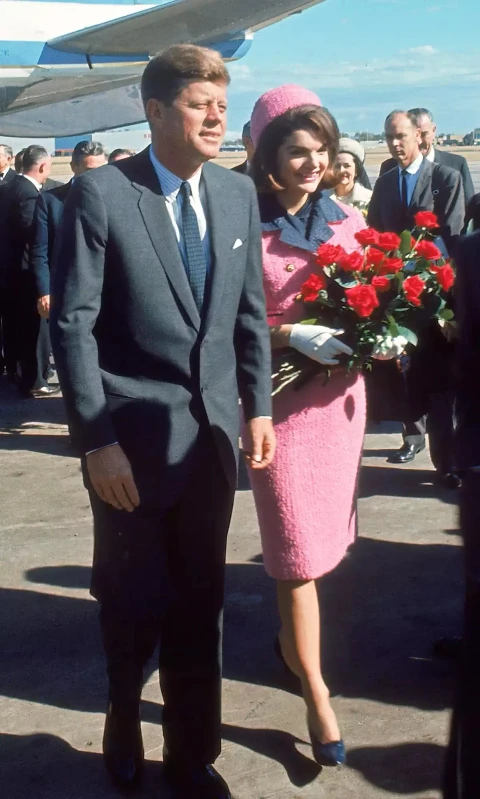
Jacqueline Kennedy, to Theodore White — Life Magazine, December 6, 1963Dallas was not where Jackie's grief began. On August 9, 1963 — just 106 days before the motorcade turned onto Elm Street — she had buried Patrick Bouvier Kennedy, her infant son, who lived thirty-nine hours. She was already in mourning when she held those red roses at Love Field. She was already surviving when everything shattered.
Place
Designed by English architect John Wind. Later declared by Stanford White the most perfect example of Greek Revival architecture in America.
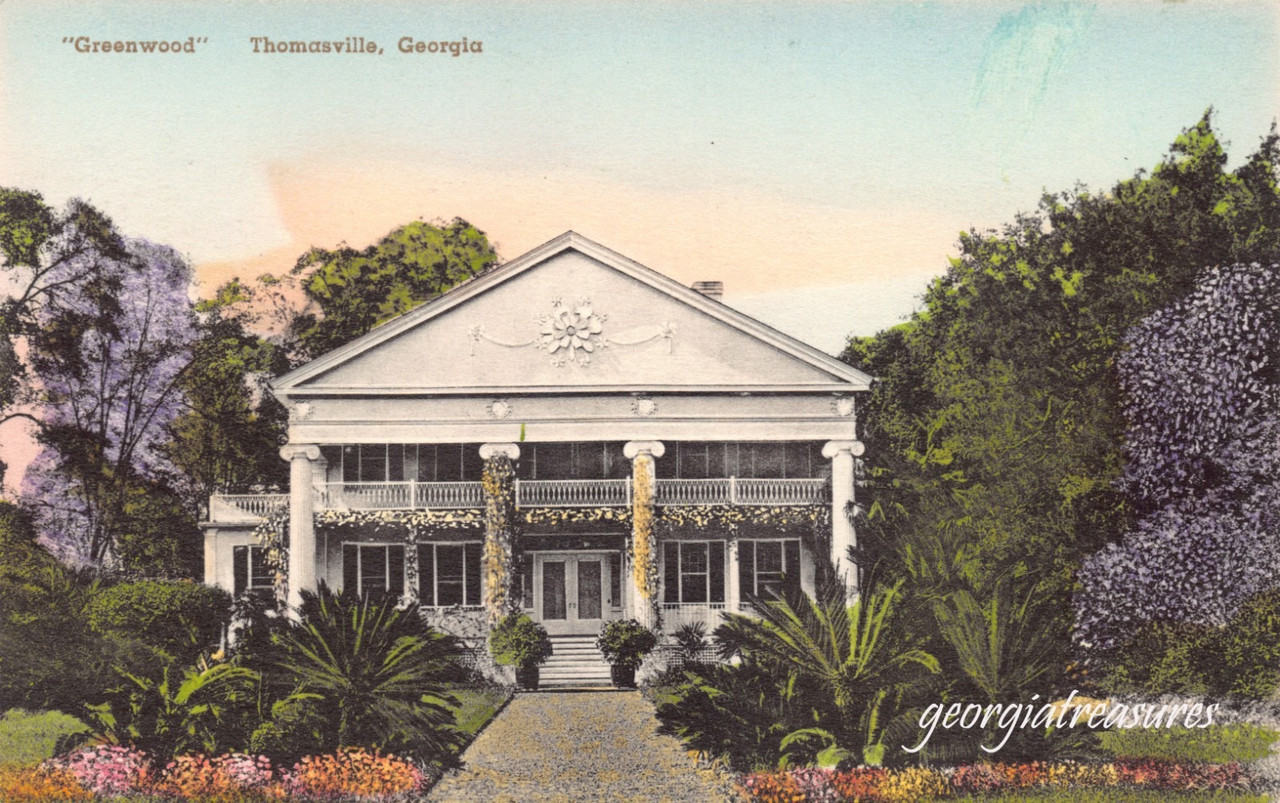
Greenwood was designed by John Wind, an English architect born in Bristol in 1819, and built between 1835 and 1844 for Thomas P. Jones, one of Thomas County's pioneer settlers. Wind — who also designed the Thomas County Courthouse and several other plantation houses in southwest Georgia — created a two-story brick and frame Greek Revival mansion with a full-facade portico, four two-story Ionic columns, and hand-carved ornamental details including magnolia blossoms and laurel wreaths. The bricks were fired in kilns on the plantation itself. The timbers were cut from the plantation and hewn by hand. It took nine years to build.
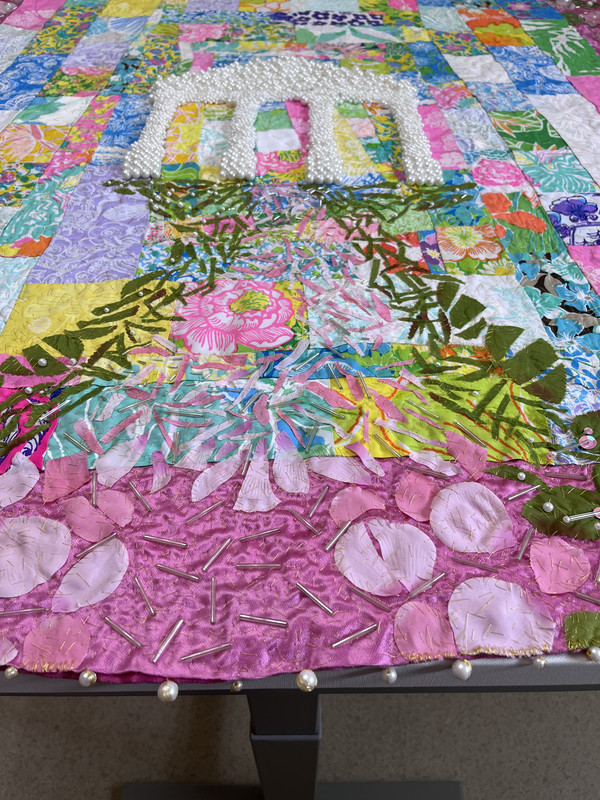
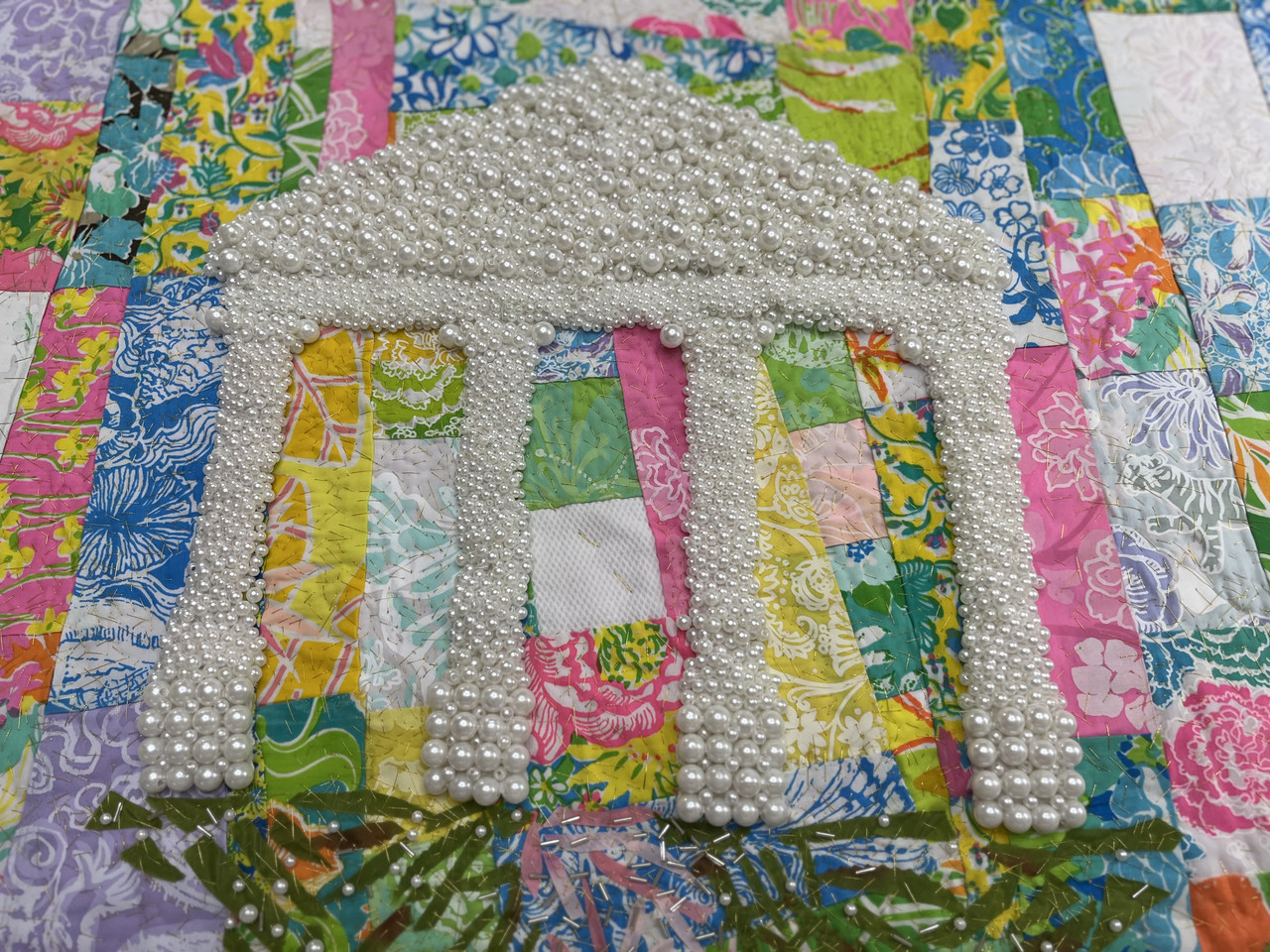
Decades later, Colonel Oliver Hazard Payne commissioned Stanford White — architect of Madison Square Garden and the Gorham and Tiffany buildings in New York — to design additions and gardens. White suggested few changes to Wind's original design, declaring it "the most perfect example of Greek Revival architecture in America." Its facade — pediment, entablature, four columns, the long gravel approach flanked by a subtropical garden — became the architectural heart of this quilt, rendered entirely in pearls.
The columns that sheltered Jackie Kennedy in February 1964 are the same columns stitched here, bead by bead, from architectural drawings traced from an 1835 photograph. The building that held her grief is built, in this quilt, from the jewelry she wore at her throat.
Greenwood Plantation, Thomasville, Georgia
November 22, 1963
Dallas
Love Field. Red roses. The motorcade. The pink suit. The shattering.
Love Field, Dallas — November 22, 1963
December 6, 1963
The Camelot Interview
Jackie summons Theodore White to Hyannis Port. She names the era. She controls the narrative. Life magazine holds the presses at $30,000 an hour.
February 1964
Greenwood
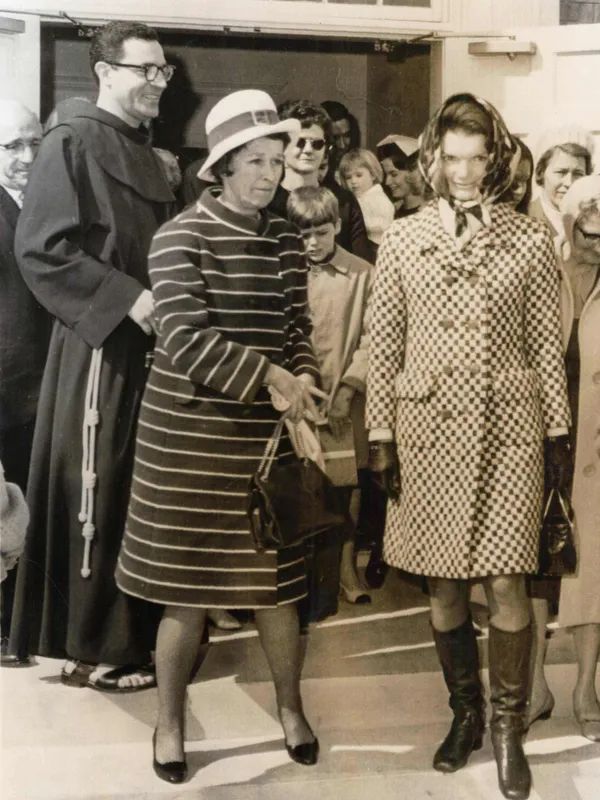
Jackie arrives in Thomasville as a guest of the Whitneys. Four days. No cameras. She attends Mass at St. Augustine's Catholic Church. She walks the portico path. She begins to return to herself.
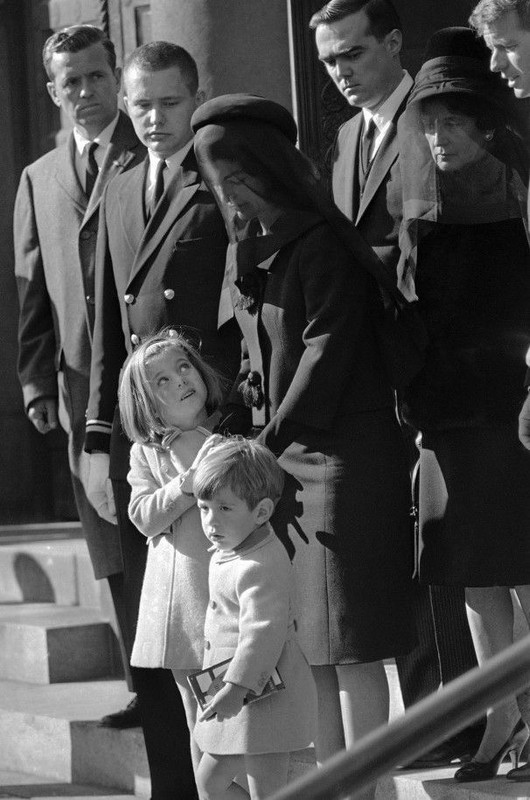
Leaving St. Augustine's Catholic Church, Thomasville — February 1964
Materials
Nothing in this quilt is decorative. Every material was chosen because it holds a layer of the story simultaneously.
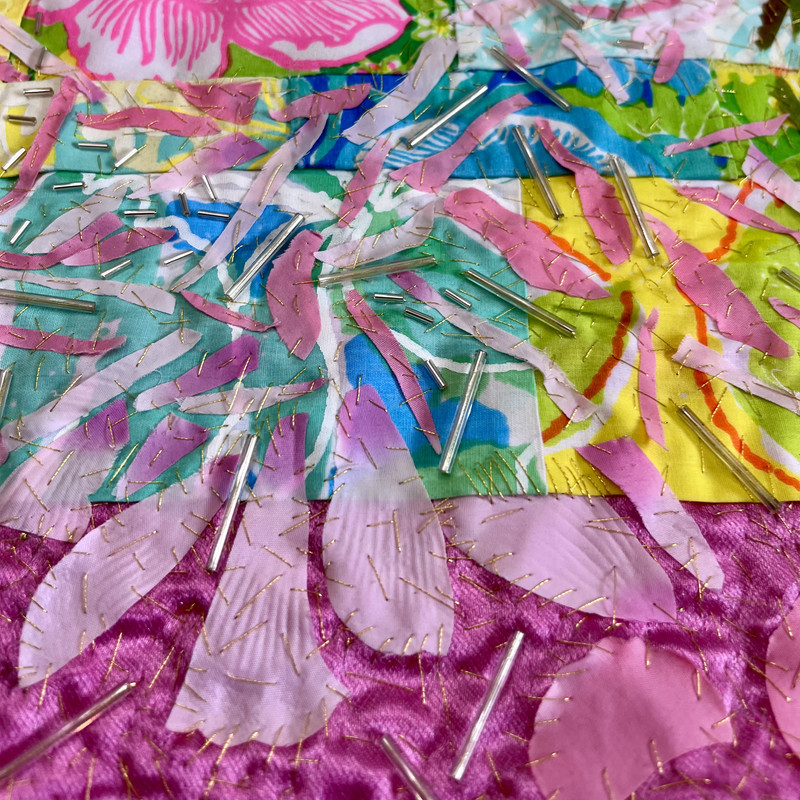
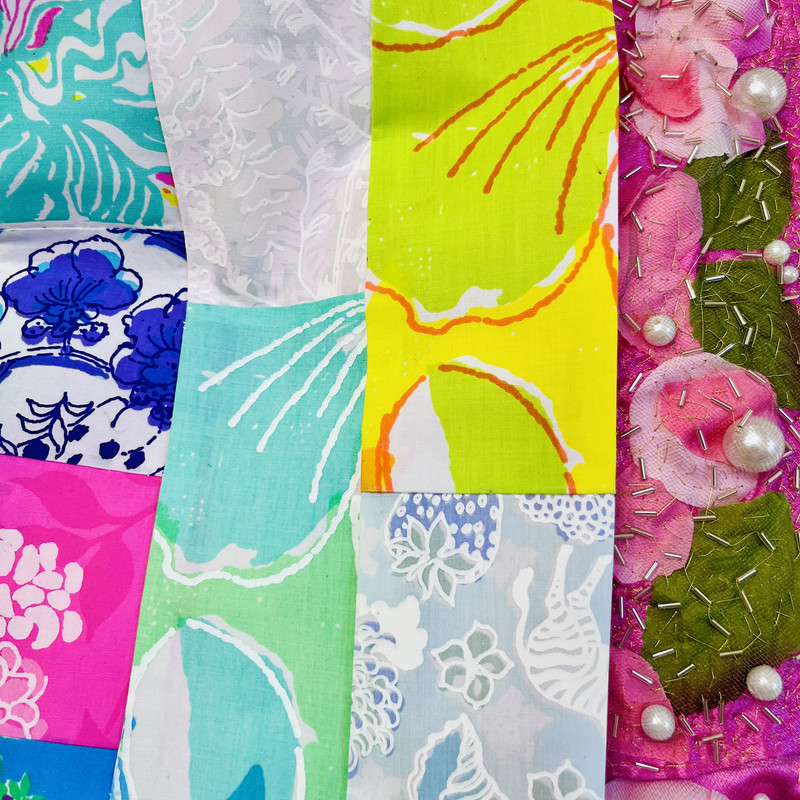
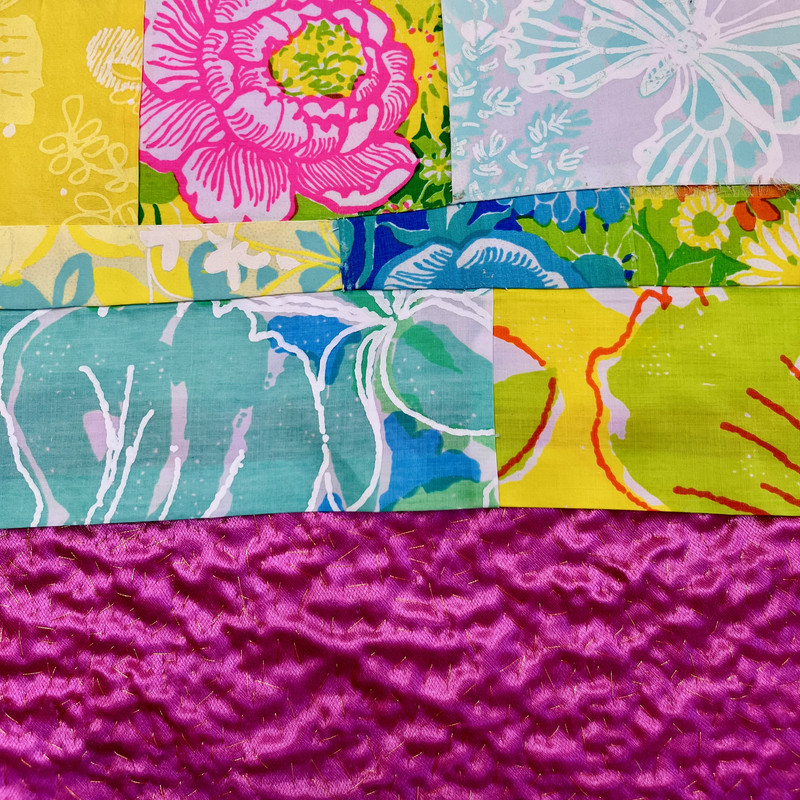
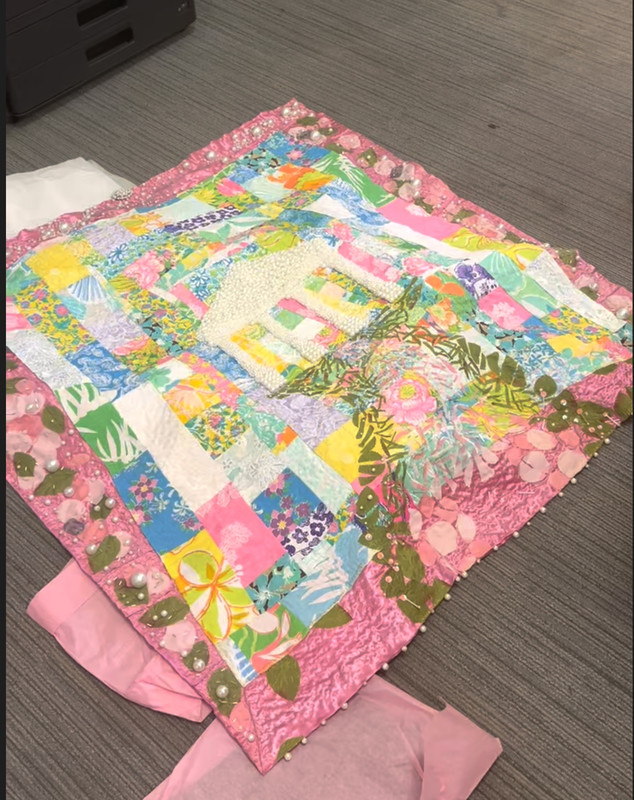
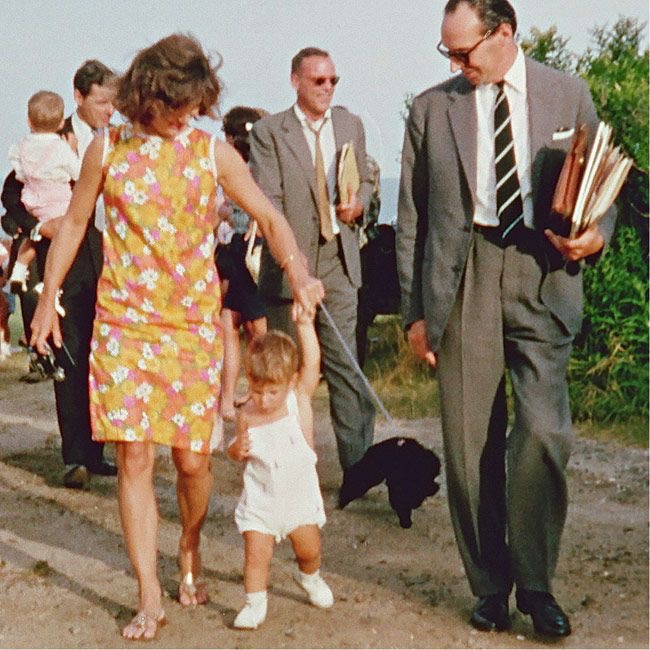
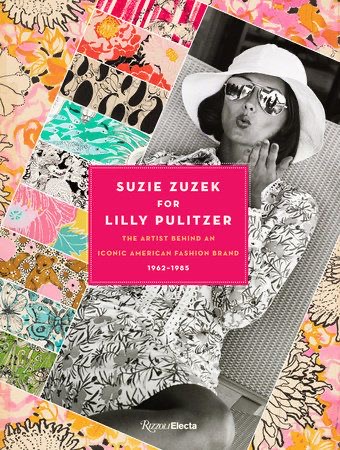
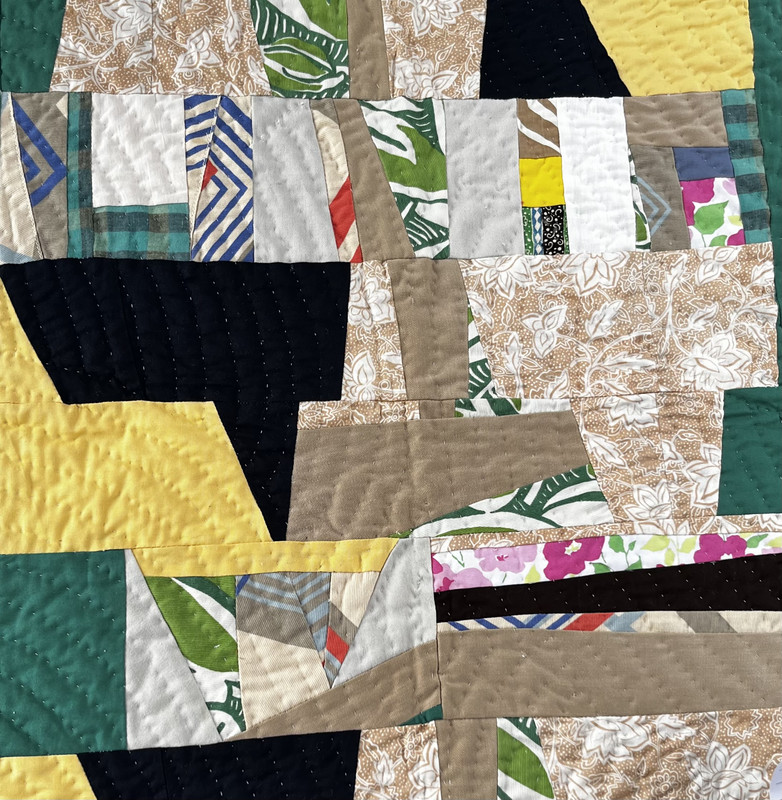
Authentic Lilly Pulitzer prints from the 1960s–70s. Jackie Kennedy wore these same prints at Hyannis Port in July 1962. The fabric of Camelot — joyful, colorful, alive — assembled in the housetop pattern of the Gee's Bend quilters. These vintage Zuzek prints represent an era of optimism and elegance, the sun-drenched world of a young First Lady before everything shattered. These fabrics are drawn from the artist's own vintage Lilly Pulitzer collection, accumulated over decades.
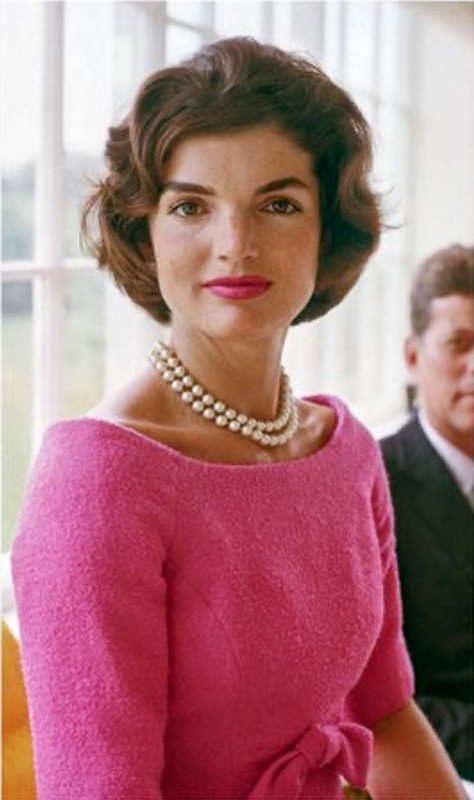
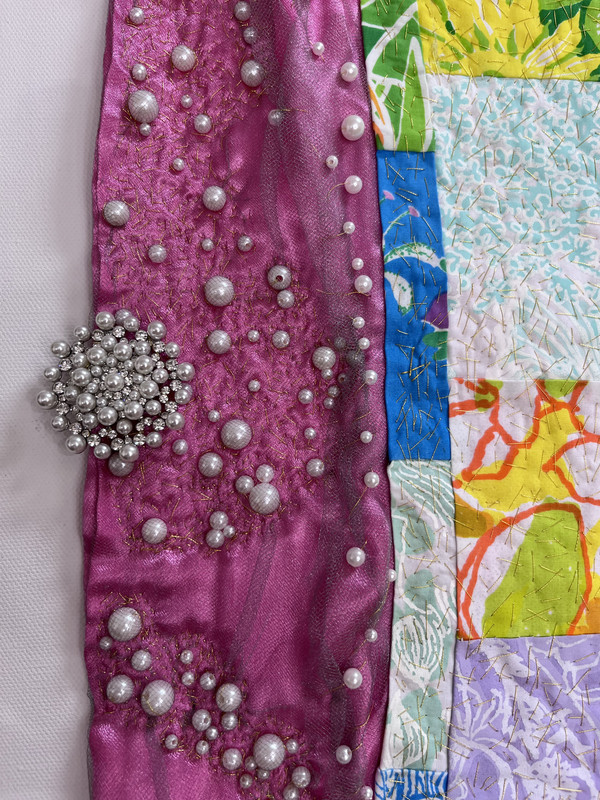
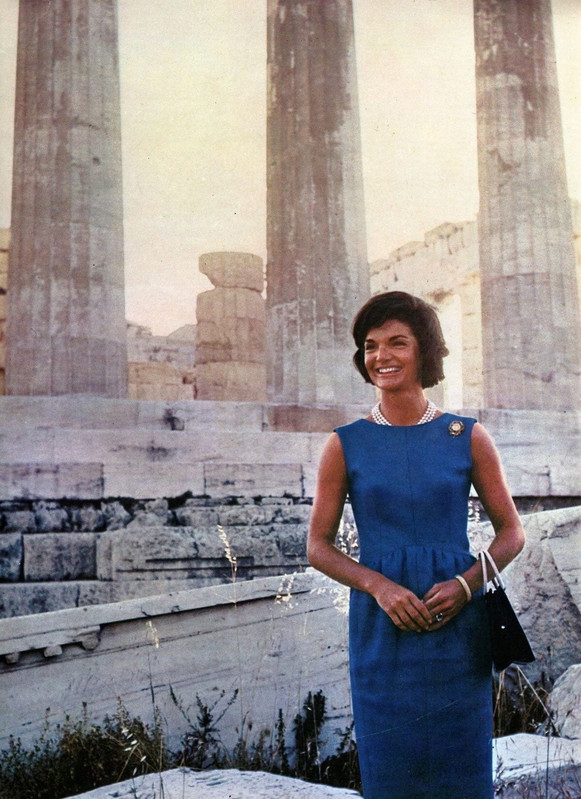
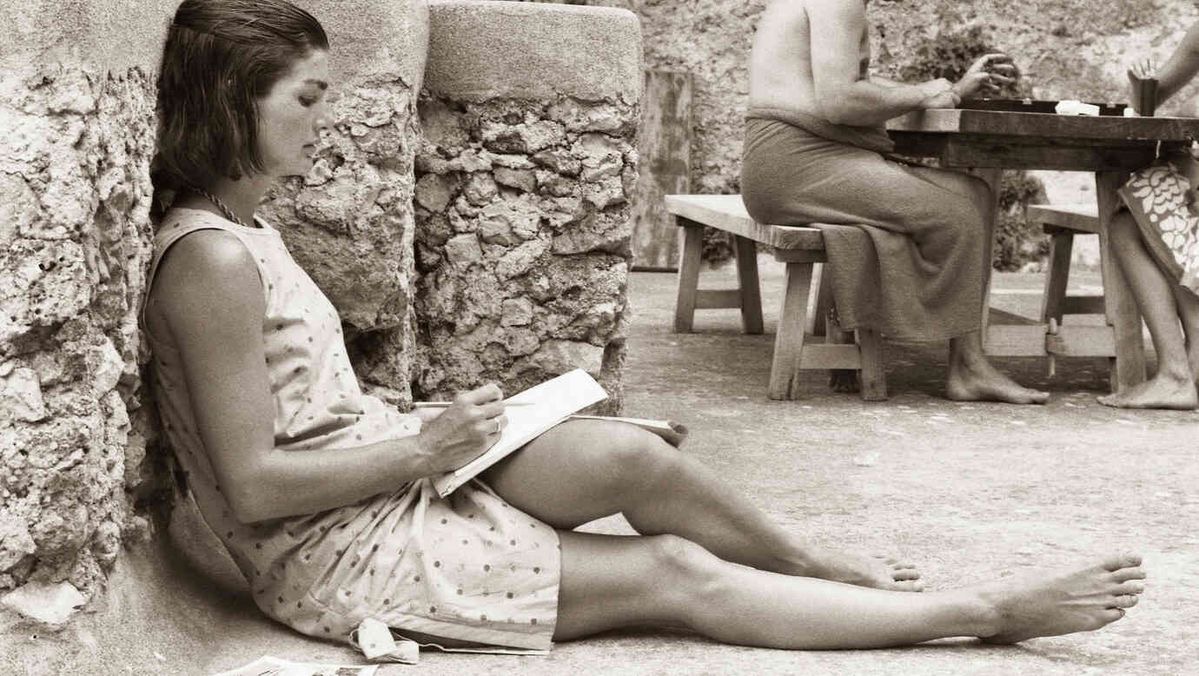
Jackie's most iconic signature — her triple-strand necklace, present in nearly every photograph. Here, hundreds of graduated pearls build Greenwood Plantation itself. Architecture constructed from identity. Refuge built from jewelry.
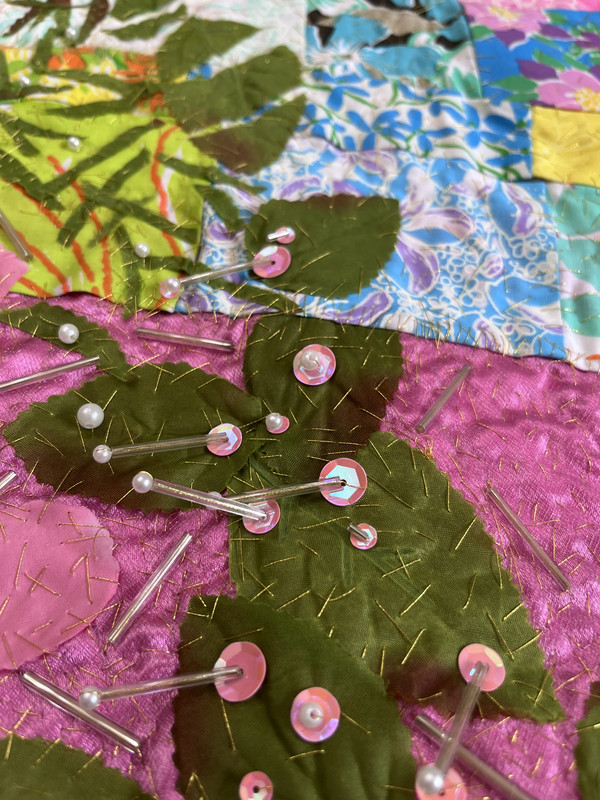
Random hand stitches scatter across both front and back. On the Zuzek front: light, sparkle, the glint of Camelot. On the pink satin back: rupture, fracture, shattering. Same stitch. Two meanings.
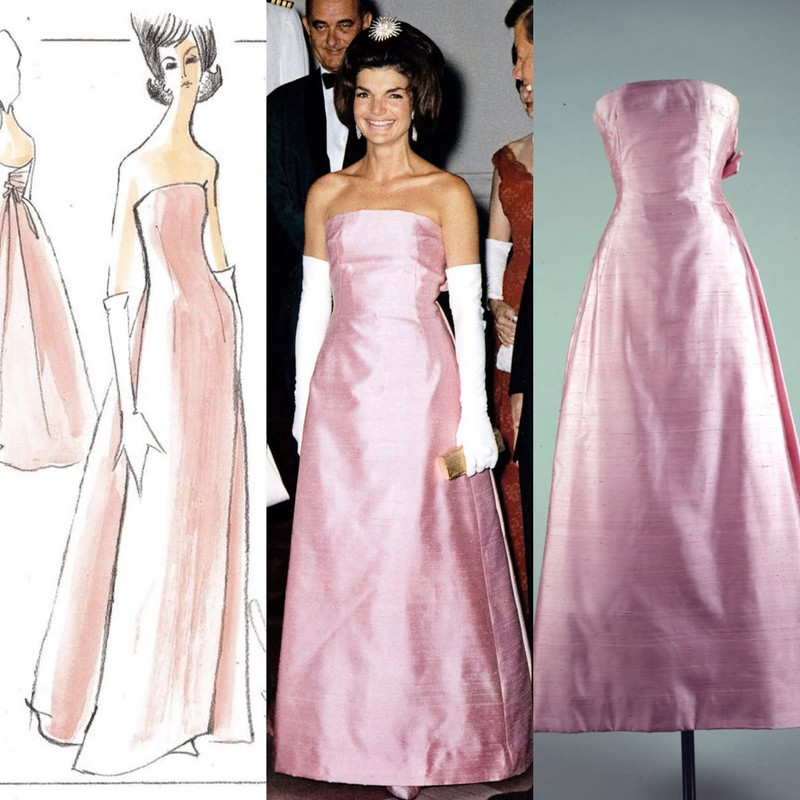
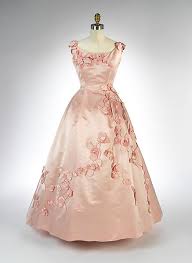
The backing is one piece of deep magenta pink satin — referencing the Oleg Cassini gowns Jackie wore through the White House years. Strapless columns of silk shantung. State dinners. The inaugural gala. The pink Jackie wore by choice.
Over the satin lies a layer of grey tulle — the veil. The color of ash, mourning, and memory. Gold thread stitches fracture and shatter across the surface. On the pink satin they read as rupture and grief. On the Zuzek front they read as light and sparkle. Same stitch. Two meanings.
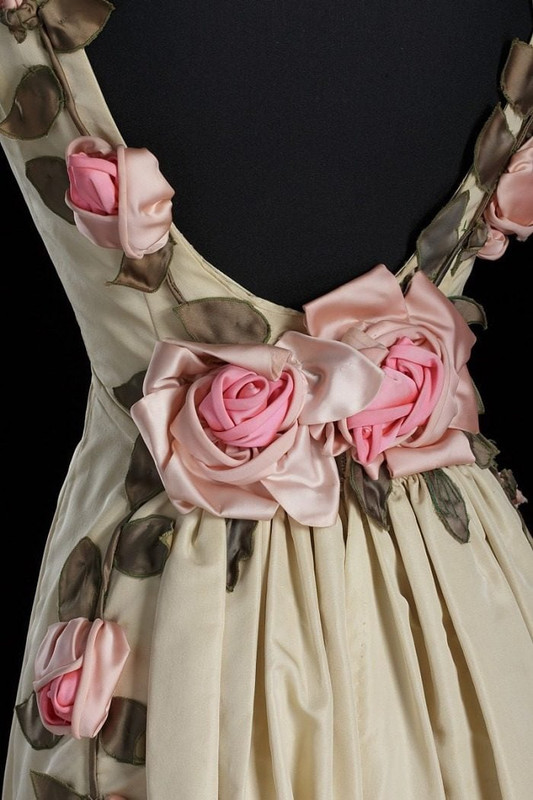
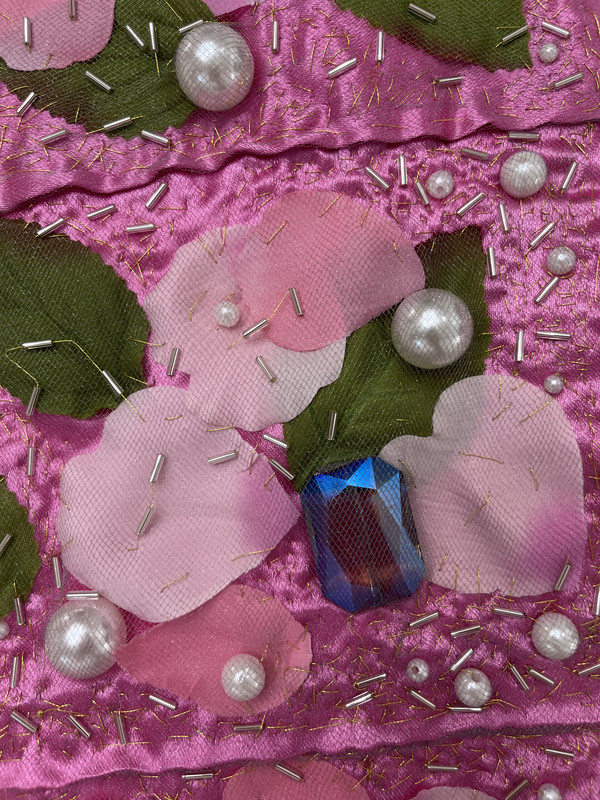
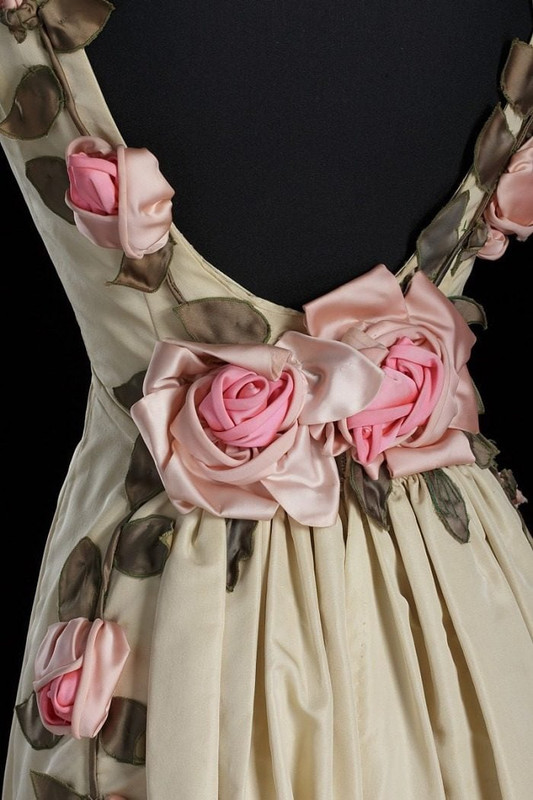
Three roses converge in this quilt. The red roses Jackie held at Love Field on November 22, 1963. The pink roses of Thomasville's annual Rose Festival — the city's most beloved tradition. And the hand-sewn satin roses of Ann Lowe, whose fabric flowers inspired the border of this quilt. One city. Three meanings. One border.
The path to the portico is made of fallen rose petals and inch-long clear bugle beads — a fractured trail, scattered and broken, leading toward refuge.
The border traps rose petals, moss green leaves, pearls of various sizes, and jewel stones between layers of satin and tulle — suspended, caught, neither hidden nor fully revealed. At the top of the frame, pearls appear loose, falling — unstrung, scattered like the world that once held them together.
Centered among them: a pearl and diamond brooch. Jackie's brooch. A staple of her iconic style — worn at state dinners, on campaign trails, in private moments and public ones.
Intact. Still pinned. A pillar of strength — everything around her shattering, she holds.
The brooch was the last detail added.
Inspiration
This quilt exists in a lineage of extraordinary women whose creative labor, beauty, and genius made it possible.
Jacqueline Kennedy
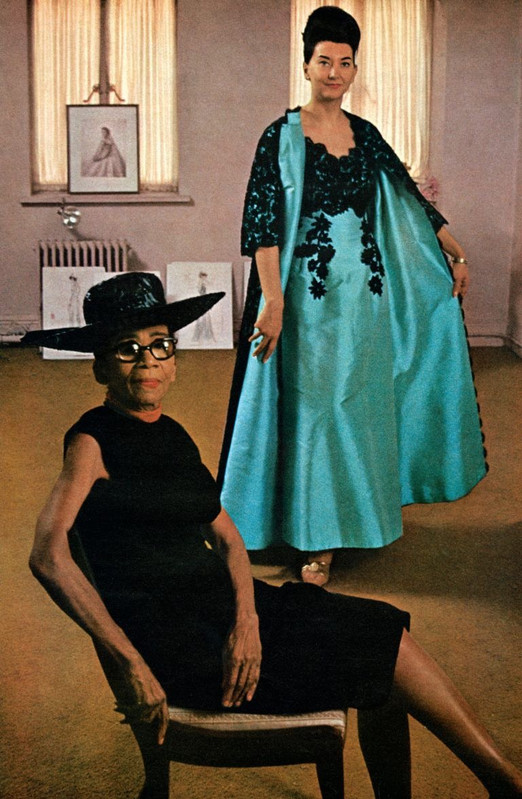
Ann Lowe
Couturière · Tampa & New York
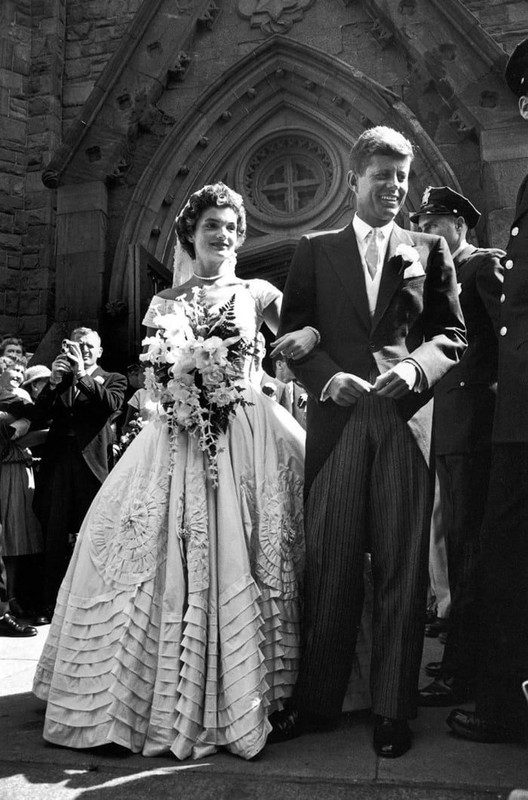
Designed Jackie's wedding dress — fifty yards of ivory silk taffeta with hand-sewn fabric roses and leaves. Ann Lowe's studio flooded ten days before the wedding. She remade everything, absorbed the cost, and told no one. Lowe's name appeared in none of the press coverage. When she delivered the dress to the Auchincloss estate, the butler directed her to the service entrance. She refused, and walked in through the front door. The Saturday Evening Post called her "Society's Best Kept Secret."
For five decades, Ann Lowe dressed the Rockefellers, du Ponts, Roosevelts, and Auchinclosses. She was the first African American to own a fashion salon on Madison Avenue. Christian Dior admired her work and invited her to collaborate — she declined, choosing to work on her own terms in America. She died largely penniless. Her clients routinely underpaid her, and she never charged enough for her extraordinary handwork.
Before she dressed First Ladies, Ann Lowe dressed Gasparilla Queens — the most coveted social appointment in Tampa, the city where this quilt's artist was born and raised. Three of Lowe's Gasparilla gowns are held at the Henry B. Plant Museum in Tampa. Her 1957 Gasparilla gown — cream silk satin with silver bugle beads, ivory seed beads, blue tulle flowers, and strands of pearls — anticipates every material in this quilt.
Ann Lowe was born in Clayton, Alabama. The women of Gee's Bend are from Boykin, Alabama. Different cities, the same state, the same unbreakable creative force — their work, beauty, and genius inspire every stitch of this quilt.
In 2024, Sony's TriStar announced "The Dress" — a biopic about Ann Lowe produced by Serena Williams and Ruth E. Carter, focused on her experience making the Kennedy wedding dress. Her story is finally reaching the audience it deserves.
"When Lowe was a child, she loved to play with the scraps left over from her mother's work, sewing and shaping them to transform them into flowers."
— Smithsonian National Museum of American History
"All the pleasure I have had, I owe to my sewing."
— Ann Lowe, Ebony magazine, 1966
Suzie Zuzek
Textile Artist · Key West
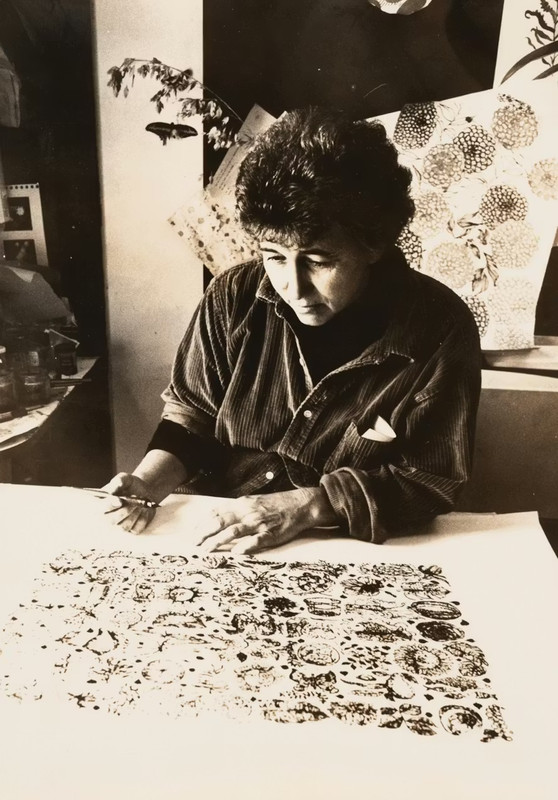
Agnes Helen Zuzek — known as Suzie — served in the Women's Army Auxiliary Corps during World War II. Afterwards she attended the Pratt Institute in New York on the G.I. Bill, graduating top of her class in textile design in 1949. She found work in New York designing prints for fashion and home fabrics. Marriage brought her to Key West in 1955. When former New Yorkers Jim Russell and Peter Pell opened Key West Hand Print Fabrics in 1961, they hired her as their designer. Almost instantly, everything changed.
In 1962, Lilly Pulitzer — a Palm Beach socialite who had started a small dress business — traveled to Key West to track down the source of some extraordinary fabric she had discovered. She walked into Key West Hand Print Fabrics, fell in love with Zuzek's designs on the spot, and placed the largest order the company had ever received. When she returned to Palm Beach, she doubled it. For the next twenty-three years, every print that defined the Lilly Pulitzer look came from one woman sitting at a drawing table on the second floor of a Key West building — Suzie Zuzek. One of her very first designs for Pulitzer was the print photographed on Jackie Kennedy at Hyannis Port in July 1962. The fabric in this quilt is from that same era.
Zuzek copyrighted every design she created. Her name appears on over 1,500 copyright cards at the Library of Congress — quietly, persistently claiming her work, even when no one was looking.
When Lilly Pulitzer filed for bankruptcy in 1984, Key West Hand Print Fabrics closed and Zuzek's entire archive disappeared. She believed her life's work was lost forever. She died in 2011 at the age of 91, thinking it gone. Five years later, Becky Smith found it under the floorboards of a Key West warehouse — crammed into dusty cardboard boxes, largely intact. When Pulitzer died in 2013, her obituary in the New York Times described the famous prints in detail. Suzie Zuzek's name did not appear.
After retirement, Zuzek never stopped creating. She turned to sculpture, painted tiles, and wood panels — a lifelong artist to the very end.
In 2021, the Cooper Hewitt, Smithsonian Design Museum presented "Suzie Zuzek for Lilly Pulitzer: The Prints That Made the Fashion Brand" — the first museum exhibition to reveal the full scope of her artistic contribution. Organized by curator Susan Brown, it featured more than 35 original watercolor and gouache drawings alongside the finished textiles and fashions they inspired. Long overdue recognition for a woman who powered an era.
"The fabulous success of the 'Lilly Look' would not have been possible without Suzie's whimsical and magical creations. I simply couldn't have done it without her."
— Lilly Pulitzer
The Gee's Bend Quilters
Fiber Artists · Boykin, Alabama
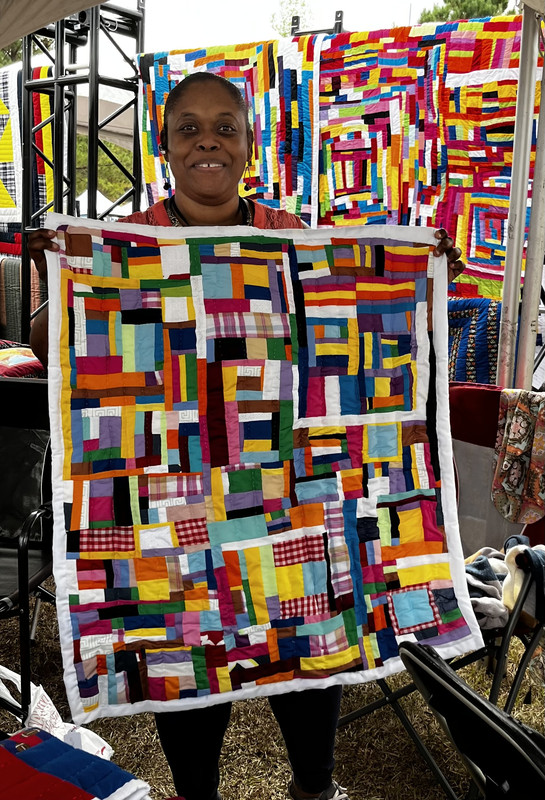
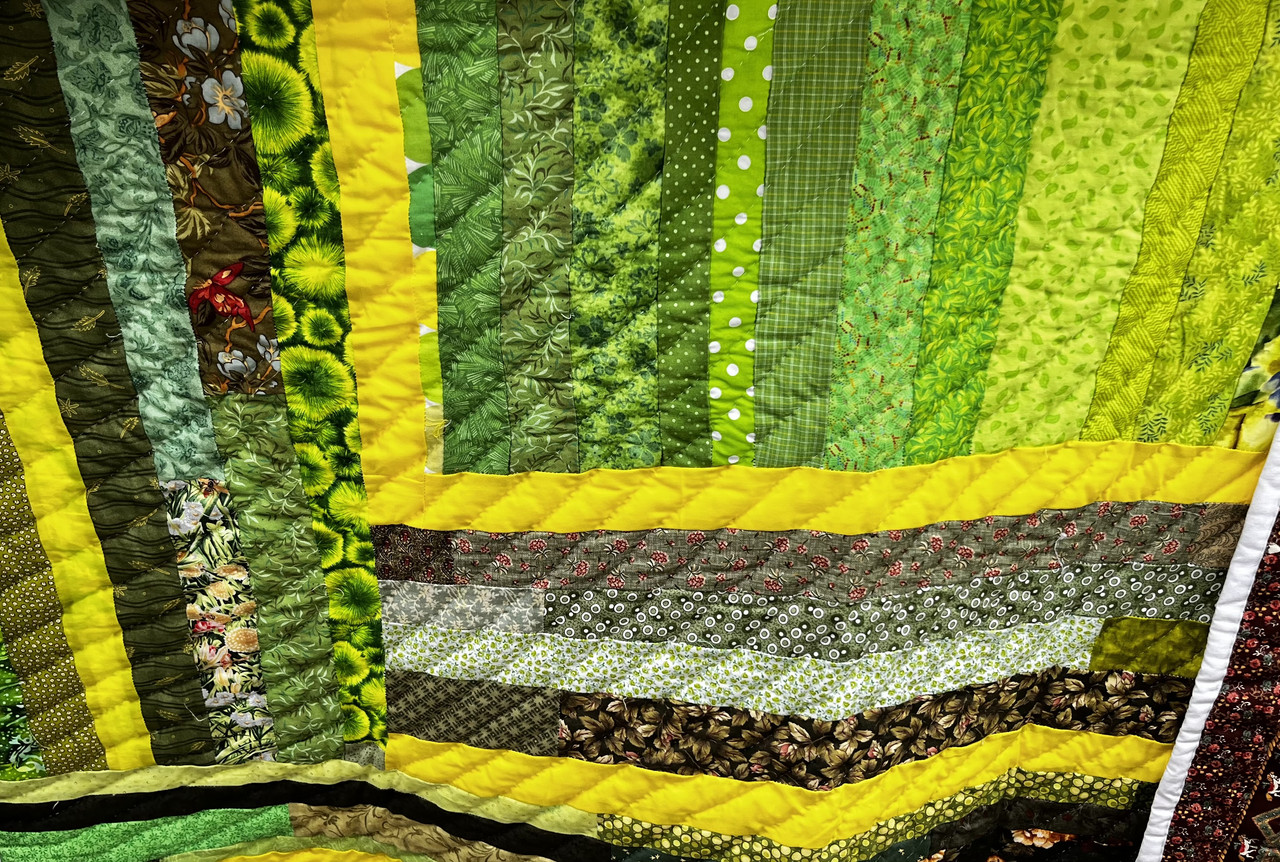
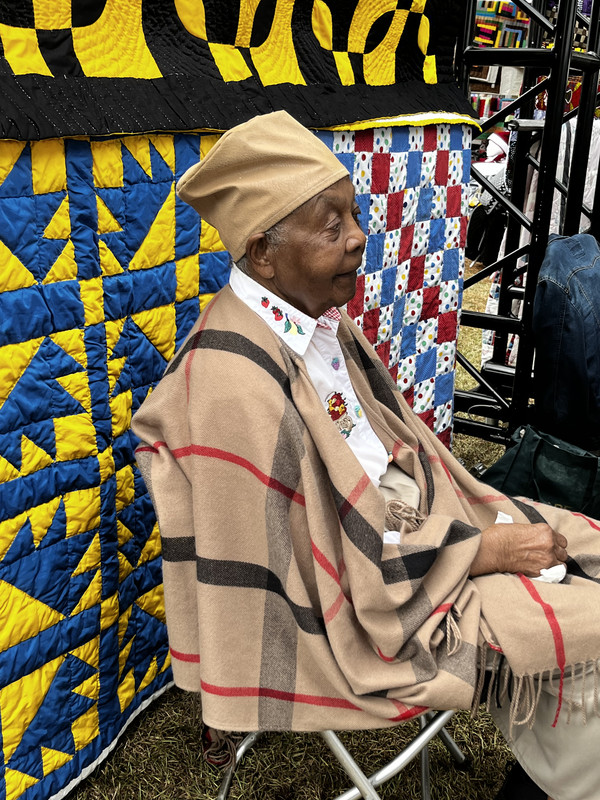
Generations of women in the remote Alabama community of Boykin — surrounded on three sides by a bend in the Alabama River — have made quilts of extraordinary beauty from scraps of worn clothing since before the Civil War. Their ancestors arrived enslaved, forced to walk from North Carolina in 1847. They stayed, and they stitched. The housetop and strip patterns they developed — improvisational, bold, structurally fearless — have been called by art historians some of the most significant works of American abstract art of the twentieth century.
In 1966, during the Civil Rights Movement, the women founded the Freedom Quilting Bee — a cooperative to sell their work collectively and build economic independence. In 2002, the Museum of Fine Arts Houston and the Whitney Museum of American Art presented the first major exhibition of their quilts. Ten of their designs became United States postage stamps.
Their 2002 debut exhibition at the Museum of Fine Arts, Houston was hailed by the New York Times — during its run at the Whitney Museum of American Art — as "some of the most miraculous works of modern art America has produced." The exhibition traveled to fourteen museums nationwide. Today their quilts are held in the permanent collections of the Museum of Modern Art, the Metropolitan Museum of Art, the Philadelphia Museum of Art, the Whitney Museum of American Art, the High Museum of Art, and more than forty museums worldwide. In 2015, Mary Lee Bendolph, Loretta Pettway, and Lucy Mingo received National Heritage Fellowships from the National Endowment for the Arts — the United States government's highest honor in the folk and traditional arts.
Each October, the community hosts the Airing of the Quilts Festival — a beloved annual tradition rooted in the seasonal practice of hanging quilts outdoors to air from storage. Families display quilts along County Road 29, the rural highway that runs through Wilcox County to the bend in the river. The festival draws visitors from across the country for quilt sales, workshops, guided tours, and live music. It was this festival — attended by this quilt's artist in October 2025 — that sparked the making of this quilt.
Their housetop pattern is the structural foundation of this quilt's Zuzek patchwork field.
"I thank God that people want me to make quilts. I feel proud and happy. The Lord give me strength to make this quilt with love and peace and happiness so somebody would enjoy it. I'm doing something with my life."
— Loretta Pettway, Gee's Bend
Artist
Jacqueline Jenkins is a South Florida-based architect and designer with thirty years of experience in luxury residential historic restoration. She holds a Bachelor of Design and Master of Architecture from the University of Florida, where she studied architecture in Italy and London.
This quilt actually began in 1991. That year, "Museum Piece" — Jacqueline Jenkins' Master's thesis in architecture — was published in the Journal of Architectural Education, with her drawing of what she designed and called "Muse Shoes" on the cover. The article examined a tension at the heart of women's creative, professional, personal and family lives — the woman as architect and the woman as homemaker, the builder and the dweller, fashion as a means of construction, the needle and the drafted line. This quilt is the continuation of that inquiry.
In October 2025, she drove to Gee's Bend, Alabama for the Airing of the Quilts. She came home and began stitching.
This quilt was made entirely by hand, with gold metallic thread, over six months — in the company of her collie, Gus.
Exhibition
My Side of the Story
Venue
Thomasville Center for the Arts
Dates
April 2 – June 2, 2026
Category
People
Website